
Outdoor lighting used to be an afterthought. A couple of harsh fixtures bolted near the door and a string of bulbs that burned out by midsummer. That era is ending, and the reason is part looks, part the plain cost of running the things.
In a market where summer power bills already strain a budget, the efficiency of patio lighting has stopped being an abstract concern. Every fixture that sips power instead of guzzling it adds up across an outdoor space that gets used most of the year.
The move toward LED and solar isn’t driven by environmental virtue alone. It’s driven by the fact that these run for dramatically less, last far longer, and free you from a maintenance cycle nobody enjoys.
The efficiency numbers that make the case
The gap between old and new lighting isn’t marginal. It’s enormous, and the federal government has put numbers on it. According to the Department of Energy, residential LED lighting uses at least 75% less energy and lasts up to 25 times longer than incandescent lighting.
Read those again, because they’re the whole argument. A quarter of the energy and dozens of times the lifespan. For a space lit several hours a night across a long warm season, that difference compounds into real money and far fewer trips up a ladder.
The longevity matters as much as the energy here. Heat is hard on everything, and fixtures you have to keep replacing are a recurring headache, so LED’s long service life is a direct answer to that. Solar takes the logic one step further by wiping out the operating cost entirely. A well-placed solar fixture charges all day in the abundant desert sun and runs at night for nothing, which in a valley this sunny is close to ideal.
Why the desert is perfect for this tech
Solar lighting lives or dies on available sunlight, and Las Vegas has a surplus of exactly that. Fixtures that might underperform in a cloudy climate charge fast and reliably here, which makes them genuinely practical instead of a novelty.
So solar pathway lights, lanterns, even solar string lights become a legitimate option for a Vegas patio, especially in spots where running electrical wiring would be expensive or disruptive. The sun does the work the wiring would otherwise do.
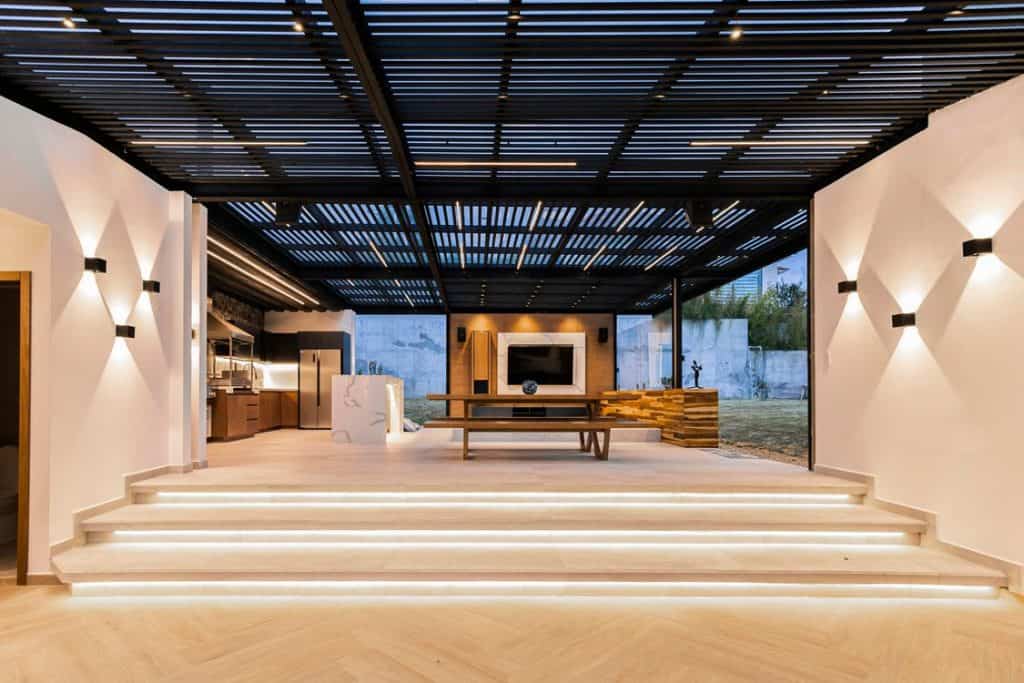
LED, meanwhile, has matured to the point where it covers every lighting need a space could have, from recessed fixtures in a cover to pendants, string lights, and accents. The tech no longer asks you to compromise on light quality or warmth. The two work well together: hardwired LED handles the primary task lighting over dining and seating zones, while solar accents fill in pathways and garden edges without adding a cent to the bill.
Building an efficient lighting plan
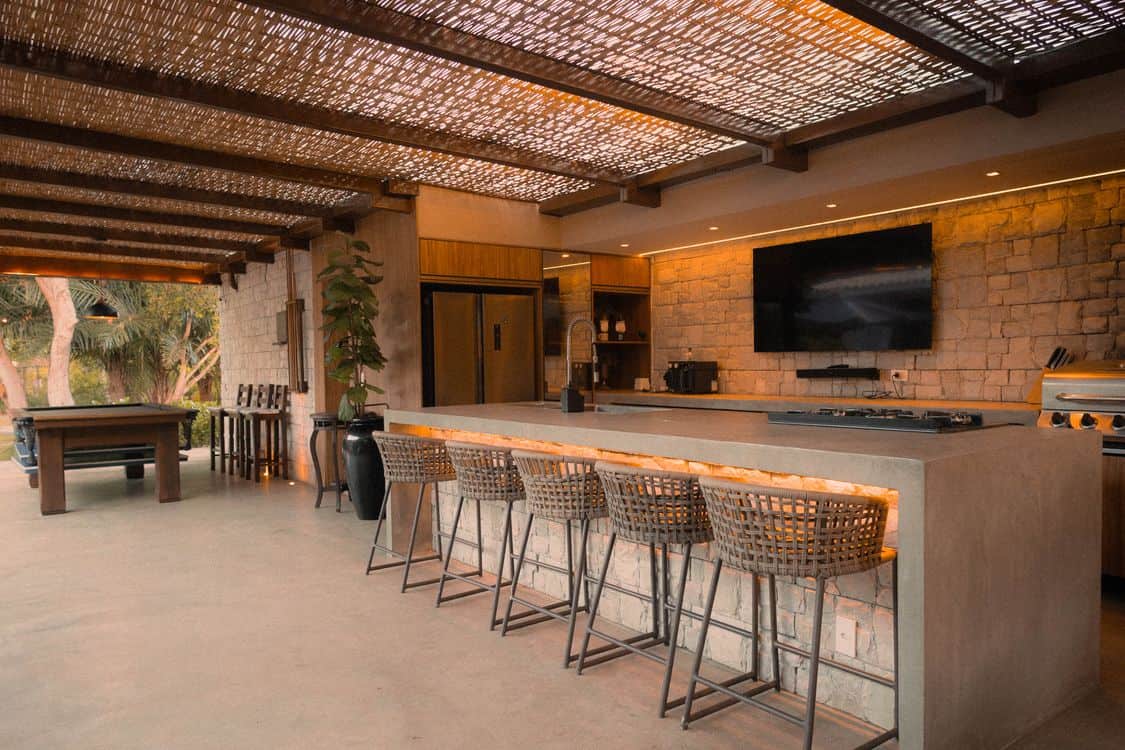
The most effective plans start with the structure. A covered patio gives you clean mounting points for recessed and pendant LED fixtures, concentrating the light where it’s actually used instead of scattering it across the yard.
Layering keeps the whole thing efficient. Rather than one oversized fixture blasting the entire area, several smaller, purpose-placed lights give you better coverage at lower total wattage, and dimmers let you dial it down further when full brightness isn’t the point. Controls are the multiplier. Timers and motion sensors run the lights only when the space is occupied, which trims energy and stretches fixture life at the same time.
Color and placement still shape the experience. Warm-toned LEDs make the inviting atmosphere people want outdoors, and thoughtful positioning under a cover keeps the light pointed where it belongs instead of leaking uselessly into the dark. The covered structure ties the efficient plan together, serving as the platform the fixtures, the controls, and the layered scheme all build around. It’s the difference between a handful of lights and an actual lighting design.
In a valley where power costs stay top of mind and the sun is relentless, the move to LED and solar is less a trend than a logical endpoint. Cheaper to run, longer to last, and perfectly matched to the desert around it.
